What Makes Card Games Fun?
In game strategy leads to the next key component - adaptability.
Each game plays differently due to variations from facing different opponents, the order of shuffled cards, and complex interactions between abilities. Players are rewarded for predicting and countering their opponent’s strategy, as well as maximizing the value of the cards they are dealt. The skill of adapting each game to different circumstances is a satisfying skill to master, and it’s why mimic characters in other games (like Olcadan or Edge Master from Soul Calibur) are so enjoyable to play.
Fans of card games are generally loyal to the genre because other games cannot substitute the specific playstyle they want. Card games have a unique combination of strategy, adaptability, and immersion, and a good card game will excel in each of these categories.
Strategy comes in two parts. The first challenge comes with building a deck.
Players look through their collection trying to find fun strategies and synergies so that they can craft a strategy uniquely their own. This discovery challenge is a complex logical puzzle that gives a deep sense of accomplishment when the deck works. This is why the lead up to new expansions is so exciting - players get to imagine how each card can be used and try to be the first to make the next meta deck.
Hearthstone is the best example of individual game variance. Random effects, card generation, and transformations that can only occur in a digital card game create a near infinite number of possible game states. The feeling that anything can happen in a game, including crazy comebacks, is one of the main reasons Hearthstone has been so successful. But this variance creates a difficult challenge for game designers to maintain the feeling that player decisions, not luck, determine the winner. Players lose the satisfaction from both strategy and adaptability if they feel they won or lost purely due to the outcome of a random effect. Early Hearthstone had major offenders - Ragnaros, Knife Juggler, Implosion, Piloted Shredder - that too often swung the game’s outcome based on a random effect the players could not control.
As Hearthstone developed, the designers gave players some control over random outcomes and this significantly improved the player’s sense of autonomy. This resulted in the best designed mechanic Hearthstone created - Discover (choose a card to keep from 3 randomly generated options within a specific category). Discover keeps game-to-game variance while giving players a meaningful choice, all while limiting potential outcomes to a defined subset that the opponent can reasonably track. This is the inspiration for Sunyata’s Evolution ability - choose a stat buff or creature transformation from 2-4 randomly generated options within the evolving creature’s type. Some evolutions offered will be uniquely suited to the current game state, and players can predict the range of outcomes based on the creature’s type and current mana value (which determines the pool of available options).
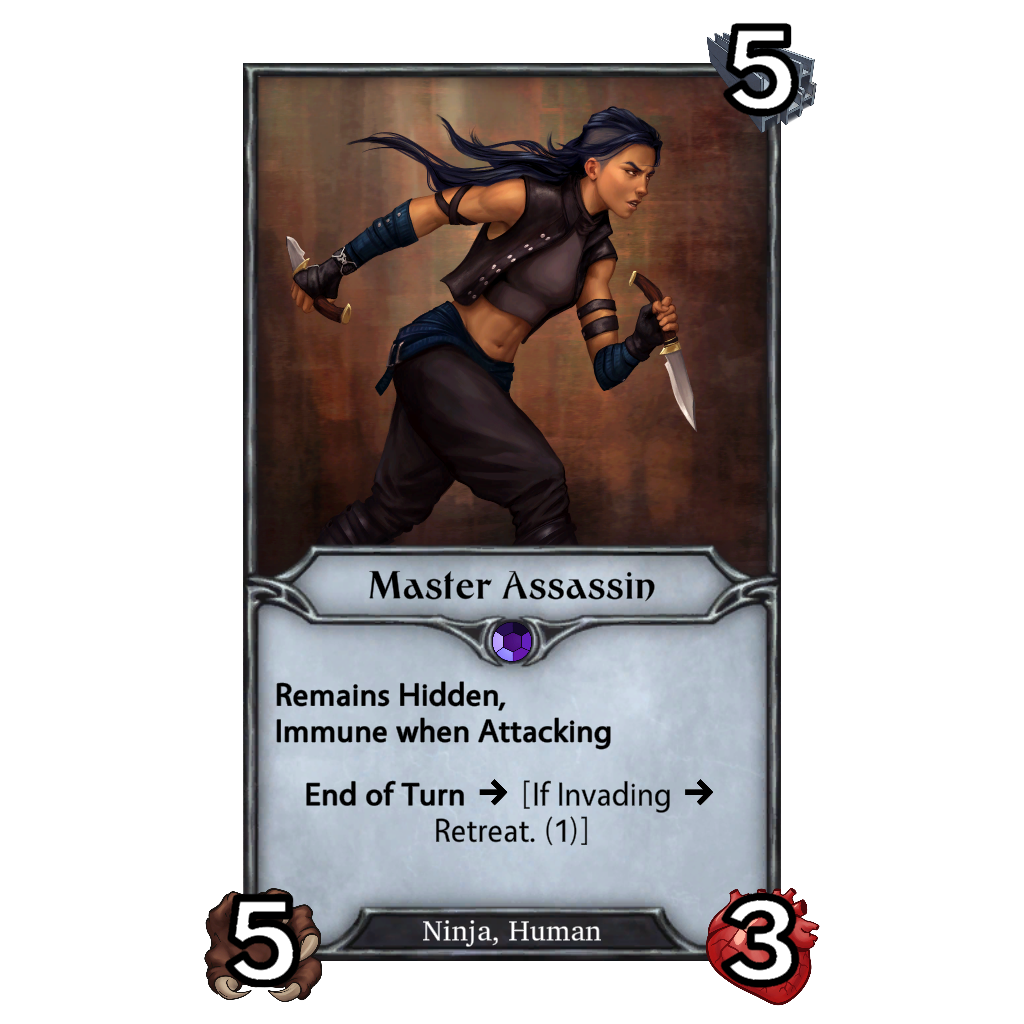
The final and most important key to card games is immersion.
Successful card games have interesting characters and fantasy elements that the player can buy into. Players want to play with powerful creatures, not a collection of numbers. Without the fantasy, a card is just a combination of attack, health, and cost values with an algorithmic ability. But with a properly designed character that matches the ability, the card becomes a massive dragon, a powerful mage, or a stealthy assassin that the player leads into battle. It’s the same feeling kids have when playing with action figures. Their imagination turns a small piece of plastic into a powerful superhero with spectacular abilities. Capturing that feeling of immersion and fantasy is what makes a game impactful, and has been the overriding inspiration when designing each card in Sunyata.